Your existing heating arrangement
- Oil / gas supply
- Existing burner
- Existing boiler or heater
- Chimney
The oil or gas burner supplies heat to the boiler or heater. The existing gas path and pollution-control equipment are reviewed during assessment.
Retrofit options for selected oil- or gas-fired boilers and thermic-fluid heaters, assessed against equipment condition, process needs, fuel compatibility and site constraints.
Discuss this service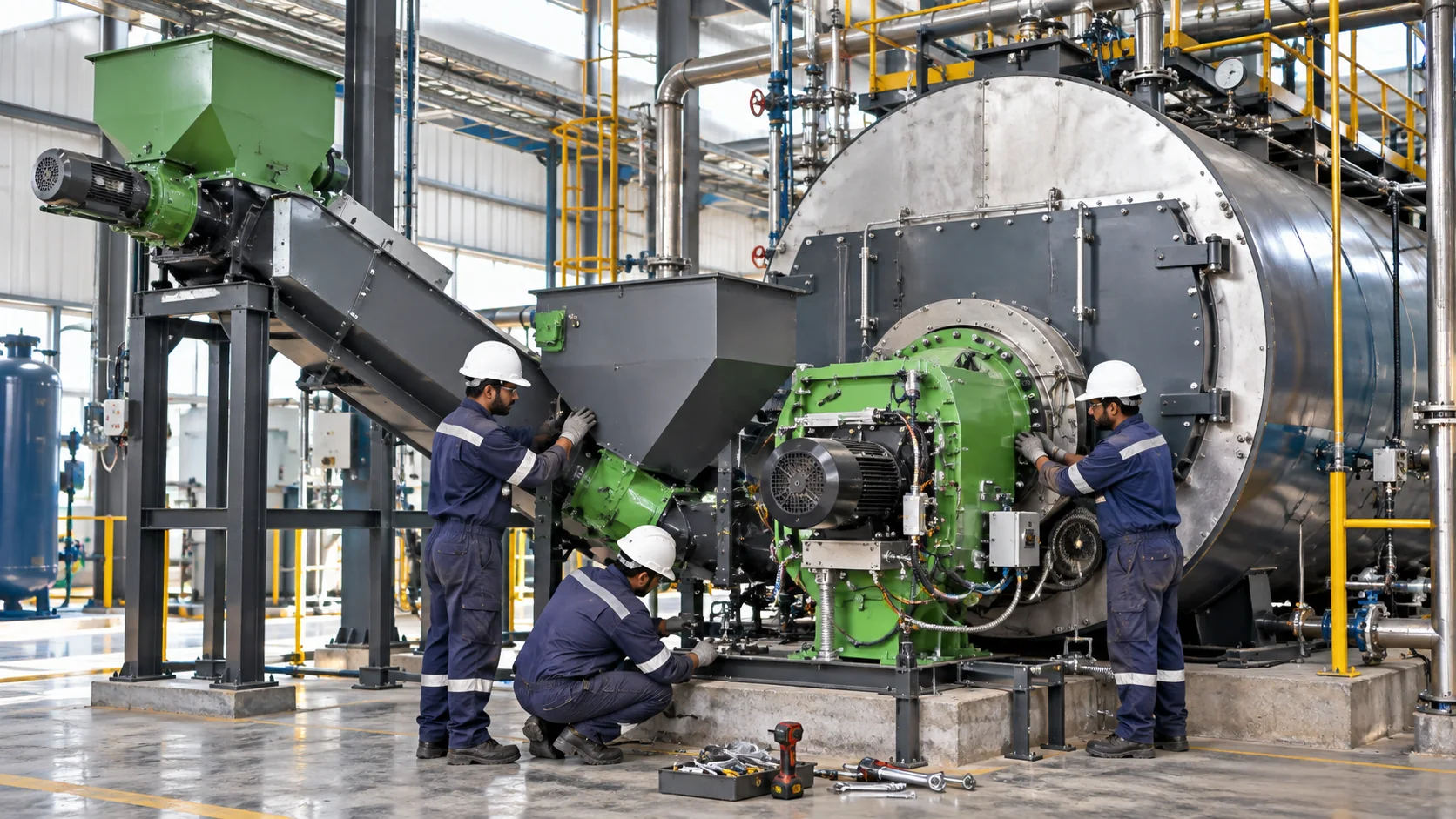
Dhruv Bio Energy’s offering lists an oil / gas-to-biomass retrofit kit for boilers and thermic-fluid heaters. Retrofit feasibility depends on the existing unit, heat load, fuel properties, burner / furnace configuration, feeding space, emissions requirements and statutory scope. A site-specific design and shutdown plan are required before confirming installation time or performance.
Final equipment and service boundaries are documented in the technical proposal.
The supplied offering contains fuel-saving and emissions figures, but these are not presented here as universal outcomes. A comparison requires current fuel prices, biomass quality, operating hours, steam / heat load and auxiliary costs. The retrofit proposal must state pressure-part boundaries, applicable approvals and responsibility for each item; regulatory requirements are verified for the actual equipment and jurisdiction.
A simple system overview showing fuel delivery, heat generation and the flue-gas route.
The oil or gas burner supplies heat to the boiler or heater. The existing gas path and pollution-control equipment are reviewed during assessment.
A suitable feeder supplies the external combustor. The boiler or heater is retained where suitable, with the heat connection, draught and particulate-control system engineered around it.
A clear route from reviewing your existing equipment to preparing your operators.
We review your boiler condition, fuel consumption and plant requirements.
We plan a suitable combustor, feeding system and equipment layout.
Equipment is fitted and connected according to the agreed project scope.
The system is started, settings are adjusted and performance checks are carried out.
Operators receive guidance on operation, routine checks and maintenance.
The final process, schedule and scope are confirmed for each project.
Boiler or heater capacity, current fuel, steam or heat demand, operating hours and location.
We discuss equipment condition, fuel handling, process requirements and site constraints.
Technical limits, responsibilities, performance basis, schedule and commercial terms are documented.
Work and follow-up are carried out against the approved project scope and contract.
Enter your plant details. Results update automatically.
Enter your plant details to calculate. Figures below start at zero.
No estimate calculated yet.
Calculate to include your figures, or contact us now.
Indicative only, not a quotation or guaranteed saving. Comparison includes fuel and entered additional costs. Financing, taxes, downtime and unentered costs are excluded. Monthly figure = annual difference ÷ 12.
Fossil CO₂ displaced estimates the original fuel's direct combustion CO₂ at full biomass substitution. Biomass stack CO₂, CH₄, N₂O and supply-chain emissions are not included; this is not net carbon reduction or a carbon-credit calculation.
Annual useful heat = capacity × load fraction × hours/day × days/year. Boiler TPH is converted using the entered heat per tonne of steam; heater capacity is converted from lakh kcal/hour. Each fuel requirement = useful heat ÷ (its NCV × its efficiency fraction).
Annual saving = current fuel cost − biomass fuel cost − (biomass kg × extra cost/kg). Payback in months = investment in rupees ÷ positive average monthly saving. Bar lengths share the same scale, so higher biomass costs remain visible.
CO₂ = current fuel input energy (GJ) × selected emission factor ÷ 1,000, in tonnes/year. Conversion: 1 kcal = 4.1868 kJ. Default factors: diesel/LDO 74.1, furnace oil 77.4, PNG 56.1 kg CO₂/GJ on an NCV basis, from IPCC 2006 Guidelines, Volume 2, Chapter 2. LDO uses the gas/diesel oil category. NCV presets are examples, not lab specifications or IPCC calorific-value defaults.
Open a question below. For advice on your plant, share your requirements with our team.
We first check its condition, capacity, heating arrangement and available space. This review confirms whether a retrofit is suitable and what changes are needed.
A retrofit aims to use suitable existing equipment with a biomass combustion and feeding arrangement. The technical review confirms which parts can stay and which need to change.
Savings depend on your current fuel price, biomass price, consumption and operating hours. Share these details so we can prepare an estimate for the same steam or heat output.
The installation plan and shutdown window are agreed after reviewing the equipment, scope and site readiness. Share your production schedule during the assessment.