Fuel-to-air balance
Review flue-gas readings and stack temperature. Excess air must be tuned to retain complete combustion; reducing it without measurements can increase unburned fuel, soot or carbon monoxide.
Review of fuel feeding, combustion practices, operating conditions and maintenance needs to identify practical upgrades for an existing boiler system.
Discuss this service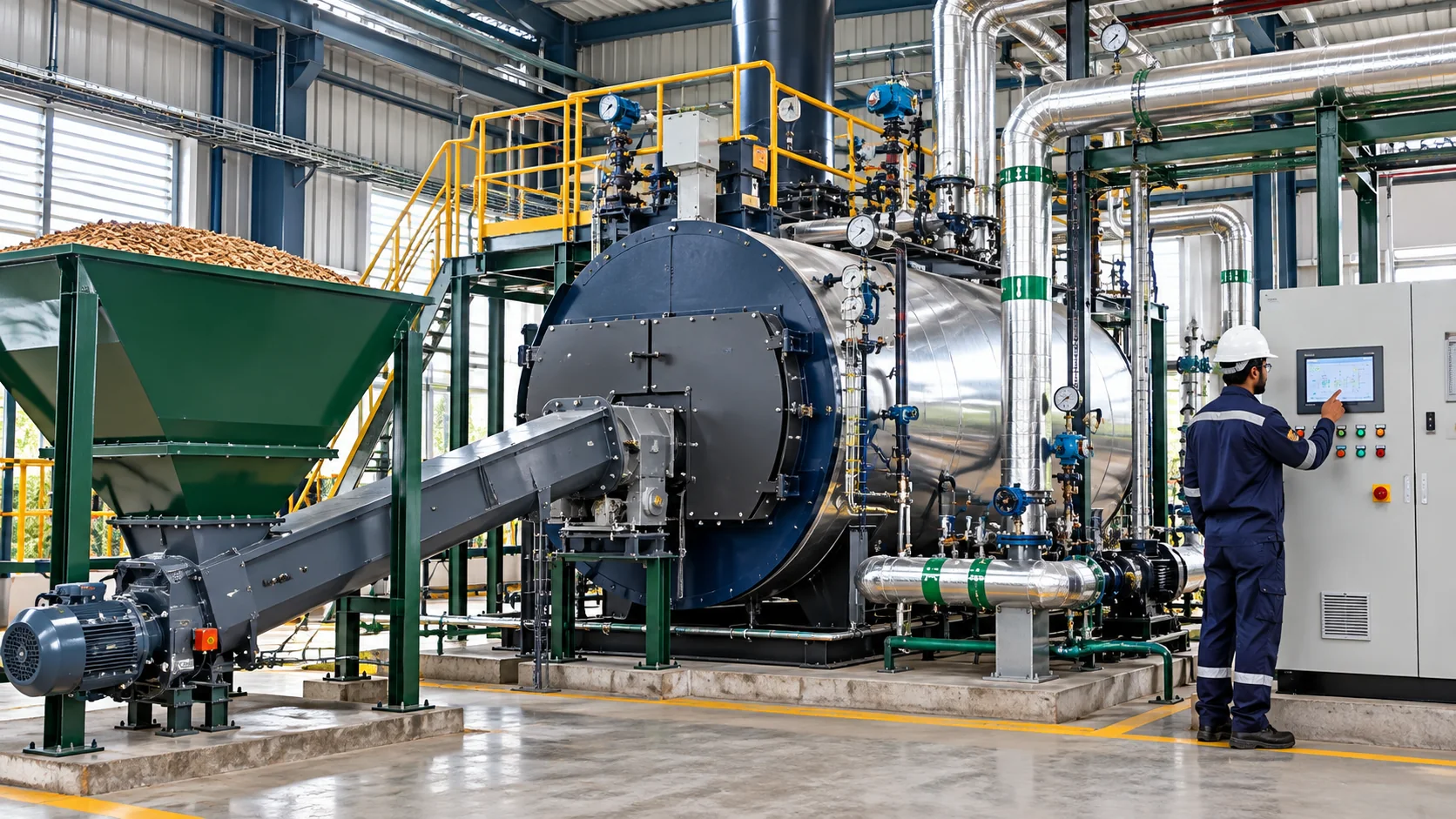
Modernization begins with a review of the existing boiler and its operating data. Dhruv Bio Energy’s offering includes automatic fuel-feeding systems and lists potential benefits such as reduced manual handling, fuel flexibility and improved operation. The company profile lists a 10–20% efficiency-improvement figure for its automatic feeding offering; this is an indicative company-document claim, not a guaranteed result for every boiler.
Final equipment and service boundaries are documented in the technical proposal.
Establish a baseline using agreed fuel, steam / heat output, operating hours and measurement methods. Compare results only after stable operation under comparable conditions. Savings, efficiency improvement and emissions depend on the boiler, fuel, load, operator practices and selected upgrades; any target should be documented before work begins.
These are assessment points, not automatic promises to supply every upgrade. Measurements and plant-specific feasibility determine the final scope.
Review flue-gas readings and stack temperature. Excess air must be tuned to retain complete combustion; reducing it without measurements can increase unburned fuel, soot or carbon monoxide.
Check fuel moisture, size variation, feed rate and unburned material in ash. Dhruv’s listed automatic-feeding range is 20–5,000 kg/h, subject to compatible equipment and fuel.
Review stack temperature, heat-transfer surfaces, deposits, insulation and visible heat loss. Cleaning, repairs or insulation work should follow safe plant procedures and the agreed scope.
Measure blowdown and water quality needs. If technically and economically suitable, assess heat recovery to preheat makeup water while retaining required boiler-water control.
Review steam and condensate leaks, condensate return, and insulation on return lines. Recovery opportunities depend on condensate quality, process layout and plant economics.
Boiler or heater capacity, current fuel, steam or heat demand, operating hours and location.
We discuss equipment condition, fuel handling, process requirements and site constraints.
Technical limits, responsibilities, performance basis, schedule and commercial terms are documented.
Work and follow-up are carried out against the approved project scope and contract.
Automatic fuel feeding is listed from 20 to 5,000 kg/h for compatible systems. Other changes are proposed only after equipment and site review.
No. That range appears in the company profile for the automatic fuel-feeding offering. It should not be applied to every boiler without a measured baseline and project-specific agreement.
Boiler capacity, current fuel and consumption, steam / heat output, operating hours, recent performance data and details of the existing feeding arrangement.
Tell us the plant location, current fuel, capacity and requirement. Our team can outline the next assessment steps.